World Building with Gravity Slingshots
Burn Fuel to Get Fast, Burn Fuel to Get Slow. Zero Sum.
Artemis II successfully completed its mission two weeks ago as of this writing. The Orion craft returned safely, screaming back to Earth at 11 km⁄s (40,000 km⁄h), or about 30 times the speed of sound. That insane velocity was hard won, yet life-threatening on return. Set aside the effort it took Orion to reach such massive speed, going to the Moon and back. Even throwing away that velocity for free would’ve been welcome. Indeed throwing away kinetic energy is one of the most expensive and difficult challenges of the entire mission.
What if a spaceship could return to earth minus the inferno? Is physics hiding some kind of regenerative braking for rockets, like an EV?
Imagine if kinetic energy were a tangible, detachable thing, like a battery, and a craft in orbit could simply disconnect it and drop it in a bucket when ready to return. The craft would then fall gently (relatively speaking) back to the surface - no massive heat shield, no scrubbing off costly orbital speed, no 3,000°F plasma bubble around it. Not only that, the bucket would store the kinetic energy to donate to the next rocket coming up.
A large mass used in a gravity slingshot gives just such a free boost, both going to space and returning. I modeled an artificially placed mass in earth orbit in an attempt to design an “onramp / offramp” for earth orbit and I’m now convinced that such a gravity assist is impossible - at the orbital level. However if scaled up to solar system level, the physics become more friendly and may hold an answer to much larger challenges.
Velocity buckets of rocket fuel would use rocket engines, an uncomfortable and stressful experience on airframes and humans alike. The velocity buckets of gravitational assist have a special comfort advantage that no rocket boost has, which we’ll get to.
Gravity Slingshot
A large mass in orbit around another mass can both accelerate and decelerate objects via gravitational slingshot, in the frame of the central mass.
Review:
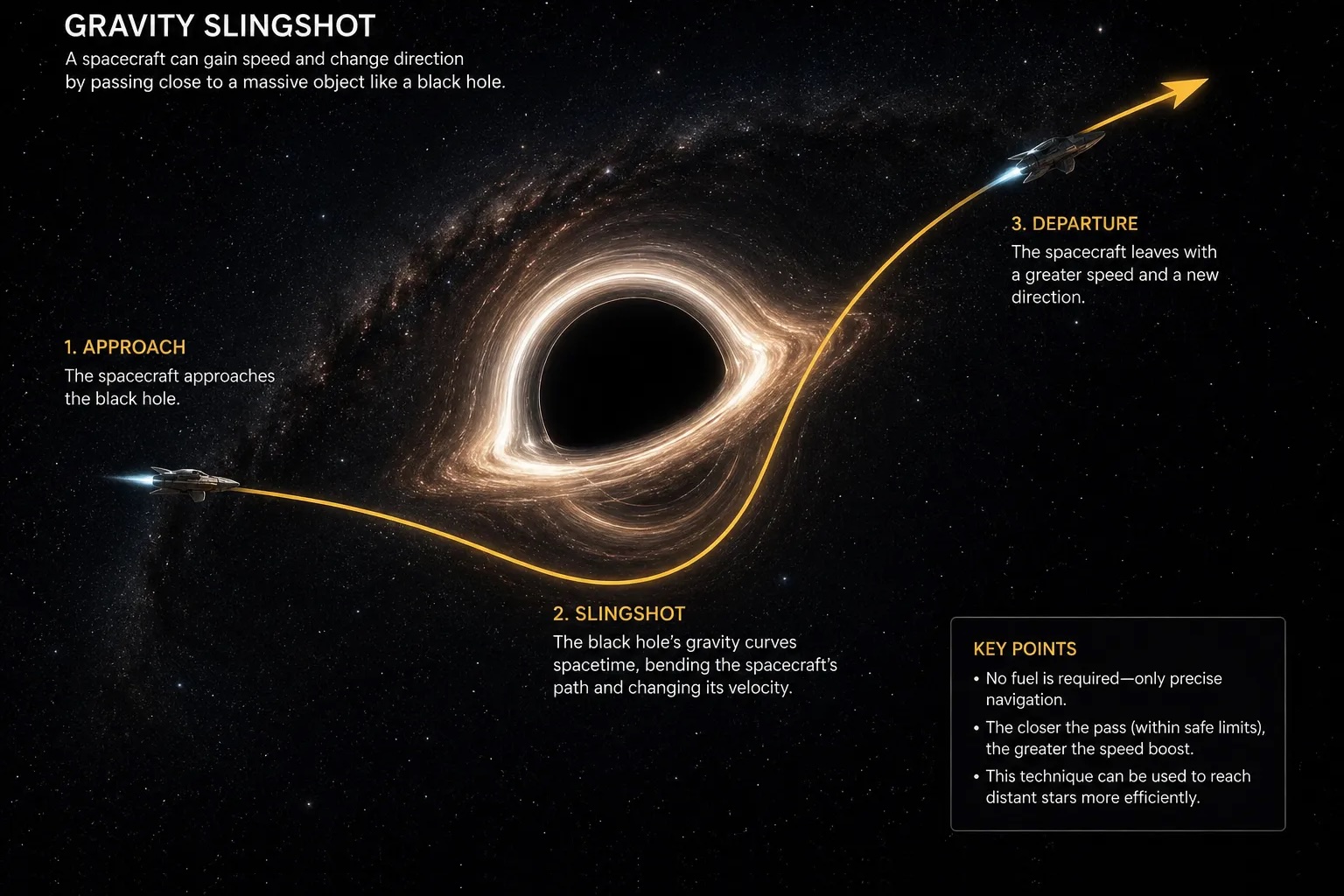
A gravity slingshot is a three-body maneuver. A spacecraft passes close to a moving body - say Jupiter, orbiting the Sun - and exits on a redirected path. In Jupiter’s frame, the ship arrives and leaves at the same speed; in the Sun’s frame, it has gained or lost velocity by exchanging momentum with Jupiter’s orbital motion. These are the “fly-by’s used by the Voyager missions to reach speeds needed to escape the solar system.
Imagine an “Artificial Slingshot Mass” (ASM) in Earth orbit that sucks rockets up when they get near it and slings them to higher orbits, or to the moon, or other planets. Craft returning from deep space whip around them and are slowed for free, for return home. It would be a helping hand in & out of Earth’s gravitational well.
Physics quickly dashed my hopes, as is its special delight. Consider our Moon. It’s 384,000km away, quite massive, and has almost never been used as a gravity assist in space missions[1]. Why is that?
For attaining Earth Orbit - useless, it’s above the orbits we want.
For slinging objects deep into the solar system: Its orbital velocity around earth is only
1km⁄s - too small.
Reality check - how much influence does the Moon have on current spacecraft reaching orbit - from low orbit up to the highest geosynchronous orbits?
Answer: barely any. It doesn’t provide any “help” getting to orbit, and its influence is tiny, though measurable on satellites in the highest orbits.
Not Realistically at Planetary Level
Now, consider the significant tides caused by the Moon. For an object to offer a significantly greater gravity assist than the moon (which gives essentially no assist), it would need to be nearer than the moon, more massive, or both. These cases present far more disruptive tides than exist now.
Conclusion: Put away your neutron star exotic materials. I don’t believe there is a scenario where an artificial gravitational mass can help climbing in or out of Earth’s gravitational well. In short, anything near enough to help on the way out is too disruptive. Push it far enough away to save the earth, and by the time you reach it, you’re already out of the well.
Even with a contrived circumstance where I can hand-tune a planet’s size, density, rotation, satellites and other factors, it is difficult to manage the competing effects of gravitational boost with tidal disruption. I did consider scenarios with tidal-effect-resistant planets (rocky, no tectonics?), but I couldn’t even world-build my way out of it. Given an advanced civilization, and a slashing of the costs getting on/off world, I still don’t see where physics prefers an ASM in planetary orbit. I’d love for someone to show what I’ve missed.
Stellar Level ASMs
I propose an ASM in a tight orbit around a star as the most plausible use case. Tidal effects are no longer a concern. Its function: to launch craft out to the deepest reaches of its system, and catch them effortlessly on their scorching returns. It can even be used to launch or receive interstellar missions. It is the gateway hub of the inner planets. As an optimization, we’ll give the mass a highly elliptical orbit. That offers even greater orbital speeds at perihelion, albeit with more complex mission profiles.
While I didn’t see how a gravity assist at the orbital level could save us from reentry heating, reentry heating at 11km⁄s is after all a solved problem… barely. Heat shield limitations and lack of margin certainly drive mission design, but it works.
An ASM can help solve future velocity-scrubbing challenges. No one dares venture heatshield solutions for 30 km⁄s, let alone 100km⁄s returns from Neptune. They just buckle down with the rocket equation and presume we’re stuck retrorocketing our way back down the well. Heatshields are maxxed out? Add more rockets. But an artificial slingshot mass in a tight solar orbit could turn that 100km⁄s return into a solved 11km⁄s problem, at zero fuel cost. Symmetrically, they can just as well accelerate a ship up to the same velocities.[2]
Of course manned missions to Neptune aren’t on anyone’s roadmap, nor is the kind of mass management an ASM would require. This is the tech-level of future centuries - we’re world-building, yet based on specific technical challenges you see on TV today. (And as long as one is world-building an ASM-capable civilization, they may also claim that orbital reentry is long solved with space elevators, mass drivers or your future-tech of choice.)
The Special Sauce - where ASMs blow away Rockets
Having found the ASM niche, Let’s plan a mission.
Suppose you have an ASM in a highly eccentric orbit, dipping well inside Mercury’s orbit.
If you were to point your rocket to meet that mass at its low point as it’s screaming past the sun around 4x Mercury’s speed, it will whip your rocket’s speed up by 20 km⁄s. And that acceleration will happen in minutes. You’d probably want to invest in some good crash couches - don’t bother.
If you picture a ship completing a hairpin turn at speeds that would squash the pilot, then consider that an object in a gravity “slingshot” is actually in freefall. No matter how tight the turn, how fast they did a complete 180°, it’s a form of orbit, they would not feel any acceleration. Einstein would tell you they merely traveled in a straight line, through the curved spacetime of the slingshot mass.
Novelist Max Harms has written a short story illustrating the experience, “The Fulcrum”.