Strange Acoustics on Mars and Beyond
I. Mars Sounds Strange
Mars sounds different than anywhere else in the solar system. Mars’ atmosphere is dispersive; high pitched sounds travel faster than lower ones. That doesn’t happen on Earth, nor likely anywhere else in the Solar System. We’ll explore this weird effect, and speculate how creatures evolving in such an environment might use it to their advantage.
You may know that the speed of sound here on Earth isn’t constant. It varies with humidity, temperature, elevation - factors that affect air density, or its ability to vibrate. But those factors which change the speed of sound never treat different pitches differently. On a given day, with a particular temperature and humidity, the speed of sound is the same for pitches high and low.
Sound is Broadband
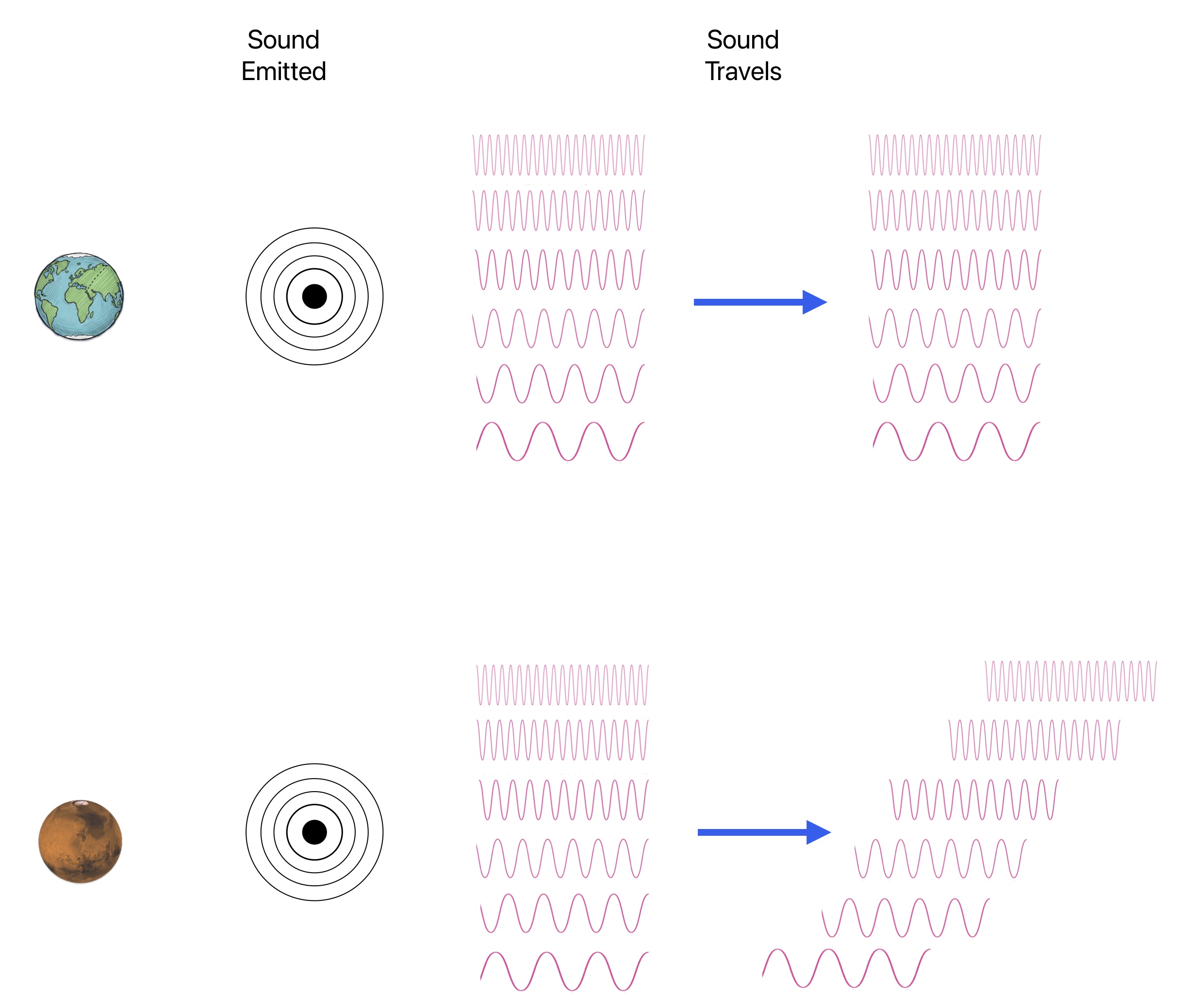
When we speak of “high” or “low” sounds, we don’t just mean someone singing a high or low note. The sound around us is made up of a broad mix of frequencies - it is broadband. It is rare for a sound to only contain just one frequency, or a small range. These are narrowband. Artificial sounds like a sine tone are narrowband, as are some bird whistles. When broadband sound travels on Earth, the different frequencies of that sound travel at the same speed and arrive at your ears together, but on Mars, it would spread out as it travels, with the higher frequencies arriving before the lower ones. It would seem “smeared” - it would be spread over time, not simply slowed down, but falling in tone as the higher frequencies arrive earlier than the lower ones.
Why Mars? CO2 Shapeshifting.
Sound transmission is often described with the “ping pong ball” model. Molecules of air bump into each other, passing a vibration from one ball to the next. Now imagine the medium is nerf balls. When you push a soft nerf ball, it doesn’t move instantly like a ping pong ball. It indents because it’s springy, absorbing energy. Then it bounces back, returning the energy, but the flexing and unflexing takes time, and the vibration travels more slowly.
Whether air molecules are being ping pong balls or nerf balls, that still wouldnt create dispersion. The trick that Mars’ 95% Carbon Dioxide (CO2) atmosphere pulls off is that it behaves like ping pong balls or nerf depending on the pitch.
CO2 molecules don’t literally get mechanically squeezed, but they absorb energy and return it in a way we can represent with the Nerf model. Importantly, this flexing only occurs when vibrations are slow enough to give them time to flex and rebound.
At higher frequencies, the vibrations are too fast for the flexing to keep up, and the molecules become like rigid ping pong balls. This variable behavior is what makes the atmosphere dispersive. The Nitrogen and Oxygen in our air can’t do that. (Mars’ atmosphere is flexing on us.)
Reality Check
Realistically, even if you could listen directly to the sounds of Mars, the first thing you’d notice would not be smearing, it’d be the quiet. Mars’ very low air density means less air vibrating against your ear. When I speak of “hearing” this effect it’s not in any practical sense. Additionally, the degree of smearing is very small - the lowest and highest speeds differ by a few percent. Sounds spread out more, the farther they travel, but it would take hundreds of meters to become noticeable. But the physics opens the door on the concept, and on a different world, with denser air or stronger dispersion, this effect could be far more dramatic.
II. Speculative XenoEvolutionary Acoustics
Imagine a planet with many times this effect, a place where, to human ears sound is audibly smeared. The atmosphere is dense like ours, so sound is transmitted well. The speed difference which causes the smearing would be greater than on Mars - perceptible at 5 - 10 meters. I claim that the dispersive atmosphere is an auditory processing goldmine.
Whether such a planet exists, or whether dispersion this strong is even physically possible, we don’t yet know. Mars broached the concept; we have scientific precedent. Let’s speculate on the evolution of life on “Disperson IVb”.
Would it be confusing and difficult to sort out environmental sounds? How might that life learn to process sound and even use the effect to their advantage?
Our evolutionary speculation rests on these tenets:
- It wouldn’t sound smeared to native life forms
- A dispersed sound carries rich information
Consider human vision. We have two eyes, but we don’t see double. Our brain combines those visual signals and creates a 3D model of the world around us. We “see” one image, even though we took in two different ones. Indeed, the difference between the images is the source of information used to represent depth.
Basic Ability
When hearing evolved on Disperson IVb, the Dispersling brains developed the signal processing ability to reconstruct a sound that Humans would consider “smeared”.
That reconstruction, while it may be a complex process is deterministic. All sounds which travel 10 meters will have the same dispersion pattern. The process to reverse that will be wired into their brains. And to be clear, the goal of the transformation isn’t simply to undo the dispersion, but to use it - reveal how far the sound traveled in the process. They will hear the locations of things around them as well as our eyes perceive depth.
Now sounds don’t just happen one tiny distinct bit at a time, they overlap, and with the dispersion, they’d overlap even more. I still claim that native life would hear sounds as compact and distinct as we do, because their brains will have sorted out the overlapping sounds and rearranged them into a rich 3D model of the world around them. This ability again shares much with our own vision. Our visual cortex compares our two images and importantly connects the parts that correlate. The Dispersling auditory processing center separates sounds which physically arrive as overlapping, but pattern-matches them to individual sources which match what they hear.
Certainly this is an expensive bit of signal processing. A Dispersling handling a heavy auditory load might struggle to bring their world into “focus” - to resolve the sounds they hear into a coherent internal representation.
Surely, Humans also perceive the difference between near and far sounds. That’s based on qualities of the sound such as echoes, or sounds being muffled vs clear. Disperslings would have that too, but the special range finding is far more precise - on par with our visual acuity.
Optimizing: Predator/Prey Arms Race
If you’re avoiding a predator, it’d suck if every step you took arrived at their ears with a full HUD worth of targeting info. It’d be important to move quietly. If you want to call or warn your buddies, you’d do so with a narrowband whistle, which has little or no dispersion. It has nearly the same form, coming from near or far, so doesn’t betray your location as clearly. Here the listener falls back on the same distance cues Humans use.
If you’re a predator, you evolve active sonar, it’s harder to fool. Consider the richness of the sonar signals, and that most life would be getting “passive sonar” for free.
Consider the mimicking talent of some birds. They not only replicate human voices, and babies crying, they can sound like squeaky door hinges, power tools, or whatever’s around. Might a clever Dispersling evolve acoustic fraud - make a sound that reassembles to simulate their location nearer or farther away? How about a sound that doesn’t reassemble to anything coherent? That’s signal jamming - making your opponent waste processing cycles. Perhaps if you couldn’t move quietly, you’d mask your steps with noise.
If one was world-building, I’d suggest a dark or foggy planet, a place where vision is less useful. The Dispersling brains would evolve around auditory processing to the degree that Earth life did with vision.
Just Scratching the Surface
This is just a peek at the trove of ideas to explore around this unearthly phenomenon. Other areas include:
- A custom Logic Audio plugin: We should be able to experience this environment firsthand now in simulation.
- James Webb Space Telescope’s ongoing observations of exoplanet atmospheres. Scientists may catalog planets whose atmospheric composition implies audio dispersion - CO2 is not the only gas with this property. Identifying more such planets can offer scientific backing for this fictional world.
- Considering the effects on communication, language, or music. Imagine sci-fi scenarios of first attempts at communication with humans.
- Other effects: Doppler, weather, Life on the ground vs air vs sea.
We will return to this speculative acoustic goldmine in future articles.
This is awesome! Great explanation, the ping pong/nerf thing was simple but helped me out as a metaphor. And of course, love a little speculative biology involving conditions that really don't show up on earth.
— eukaryote
If you do write more on this, I would be curious to see a simulation of they type of mapping that could be possible with this effect.
— jehan
Thanks Jehan, will do. It seems to me that all the parallels with RF would hold up.
— Avi