Bad Backs
Chapter 1. The First Generation
My Dad was born in 1934 in Bridgeport, Connecticut, with a reject for a spine that twisted as he grew. Babies grow a lot, mind you, it’s their day job. By the time he was three, his parents were told that he needed surgery to straighten it out.
My grandparents ran a ladies’ shoe store, as did solid middle class Ashkenazi. They were the type to look up the best Doctor in New York City and promise they’d pay him somehow, eventually.
My Dad carried on his parents’ approach. Some things, like college - it wouldn’t matter if you got into the most expensive college in the country, you don’t think about what it costs. You take money out of the decision and figure that part out later.
But a new Atari cartridge - oh sure, now cost is an object.
This orthopedic guru was Dr. John Robert Cobb, based at the - you should probably sit down -
Dr. JR Cobb at the Hospital for Ruptured and Crippled Children, at 321 East 42nd Street, Manhattan.
Just think of the poor ruptured children! and hand me the rubber cement, pity that one on the end is still leaking.
Dr. JR Cobb famously designed the “the Cobb Elevator”, which is not actually used in grain silos, but is an instrument for spinal surgery still employed today. Well, maybe also used in grain silos, if you happen to be performing spinal surgery in one.
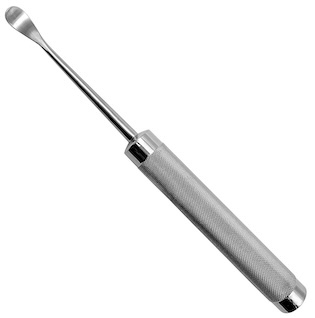
In scoliosis patients, spinal curvature is described by the Cobb Angle, a measure he originated which has been inscribed over innumerable spinal x-rays ever since. Every six months, my doc used to trace it with a grease pencil & protractor on my own films; I’d watch, waiting to see my Cobb angle - is it holding steady or growing? If it gets to 20° I have to wear a brace. By my son’s time, it was printed onto his films automatically.
As for my Dad, it’s true the poor little guy got sent off to a Dickensian-named institution. (Dickens? - so goyische), yet indeed he was fortunate to be treated at the “the birthplace of spinal fusion”, the state of the art for medicine, and first scoliosis specialty clinic in this country.
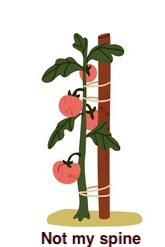
Spinal fusion surgery, for those not as intimately aware, straightens a bent spine. A straight thing is grafted to the spine to hold it in place. This isn’t so much like a stake that holds up a tomato plant. While that’s part of it, the more important process is fusing the vertebrae to each other into a solid row. The graft is there as a template. At the time, the best source for this bone graft was the patient himself. However a toddler’s tiny skeleton offers no surplus of bone, so it would have come from some animal. Preferably Kosher.
The “Tomato Stake” method of straightening spines came later, in the 1960’s with the introduction of stainless steel Harrington Rods.
I am happily Harrington-Rod-Free ( just checked, yup still no Harrington rods)
1937 was a time when “state of the art” meant parents were “too distracting” for healing. They were likely limited to visiting just an hour or two per week, often just on Sunday afternoons. Not much about that experience was told in family lore, aside from him having spinal fusion as a toddler. Given what I’ve now learned about that process, that’s likely for the best. It would’ve been a nightmare, and not a brief one. The more charming family history came from his second spinal fusion surgery around 1947.
For my Dad’s second fusion at age 13, the graft came from his left tibia. I can picture the surgery scar on his shin. Once again the misbehaving spine was pulled straight[1] and surgically fixed to the graft. While the graft and vertebrae grow together, the spine must be firmly supported in that straight position - externally, with plaster of paris. The Ruptured child was cured by spending a year in a body cast, holding his spine perfectly still. Kids were at that hospital long enough that it had an actual NYC public school inside it. My Dad would have attended Manhattan PS401, from his hospital bed, wrapped in plaster.
If my Dad truly was in Manhattan when the B-25 bomber hit the Empire State Building, as he claimed, then that certainly fits with the location of the hospital, which by then, thank God, was renamed the “Hospital for Special Surgery.” At the time there were few other high rises to block the view. An upper floor room could have looked out on 42d street toward the Empire State, 10 blocks to the southwest.
But the date of the crash was July 28, 1945, when he’d have been only 11, and we’re pretty sure the second fusion surgery was closer to age 13. However, it’s still plausible he was there that day, given years of intervening treatments and appointments.
We know he was 13 around the second surgery because that’s the Bar Mitzvah year. He needed to be out of the body cast for his Bar Mitzvah.
Editor’s note: The single thing worse than being stuck in a bodycast for a year, would have to be: getting stuck in a body cast for a year, studying Haftorah.
The year came to an end, as every year is obliged to, no matter how miserable. His body cast was removed and he was free again. His parents of course couldn’t share this moment, but would see him at the next scheduled visiting hours. When the visiting time arrived, he hopped off his bed and greeted them at the door himself. And his loving mother looked down at him briefly and said,
“Hello, we’re here to see our son, Sidney. Is he here?”
Back home and having his body returned to him he became a regular kid again, skipping hebrew school, playing football in the yard - promptly breaking his weakened left leg.
The “plank” removed from the tibia as a graft is substantial, and this was in the “immobilize everything” era. His leg wasn’t rehabbed from that bone loss the way it would be today. Medicine today understands that bones heal with moderate usage and atrophy with disuse.
His shin didn’t stand a chance, and he had his Bar Mitzvah on crutches.
If you’re curious how, the answer is: We’re not gonna talk about that. ↩︎